A useful B2B cold email connects a specific reason for writing with a relevant offer and an easy response. The templates below cover seven situations. Choose the situation first, then replace every bracket with something you can verify.
These are new writing examples, not tested campaign winners. They do not include a claimed reply rate. Add your real identity and appropriate opt-out wording before sending; the short examples focus on the message itself.
1. A hiring signal tied to a problem you solve
Use this when a public job listing reveals work your service actually covers. Hiring does not automatically mean the company wants an agency. Offer something useful alongside its hiring plan.
Subject: [role] at [company]
Hi [first name],
I saw you're hiring a [role] to own [specific responsibility from the listing].
We run [the piece of that work you actually provide] for [relevant type of business].
I can send a short outline of what that could look like alongside the hire. Worth sending?
Before using it, save the listing URL and check it is still open. Replace “specific responsibility” with an actual responsibility, not a guess about an internal problem. If your offer would not make sense alongside a hire, choose another angle.
2. A narrow observation with a useful next step
Use this when you have looked at the company's public website or process and can explain a specific improvement. A compliment about its design is not the observation.
Subject: [specific page or process]
Hi [first name],
On [page], I noticed [observable detail].
One option would be [concrete change], so [plausible benefit without a made-up number].
We work on [relevant service]. Want me to send the short breakdown?
Write the breakdown before offering it. Do not say you recorded an audit if there is no recording. Avoid diagnosing a broken sales process from a single page. Describe what is visible and label your proposed change as a suggestion.
3. A relevant result, with its limits intact
Use this only when you have a real result and permission to use it. Keep the measurement and timeframe attached to the number.
Subject: [specific outcome] for [type of team]
Hi [first name],
We worked with [approved client or accurate description] on [specific job].
Over [timeframe], the campaign produced [verified result, using its original definition].
Your [observable similarity] made me think the approach might be relevant. Want the campaign breakdown?
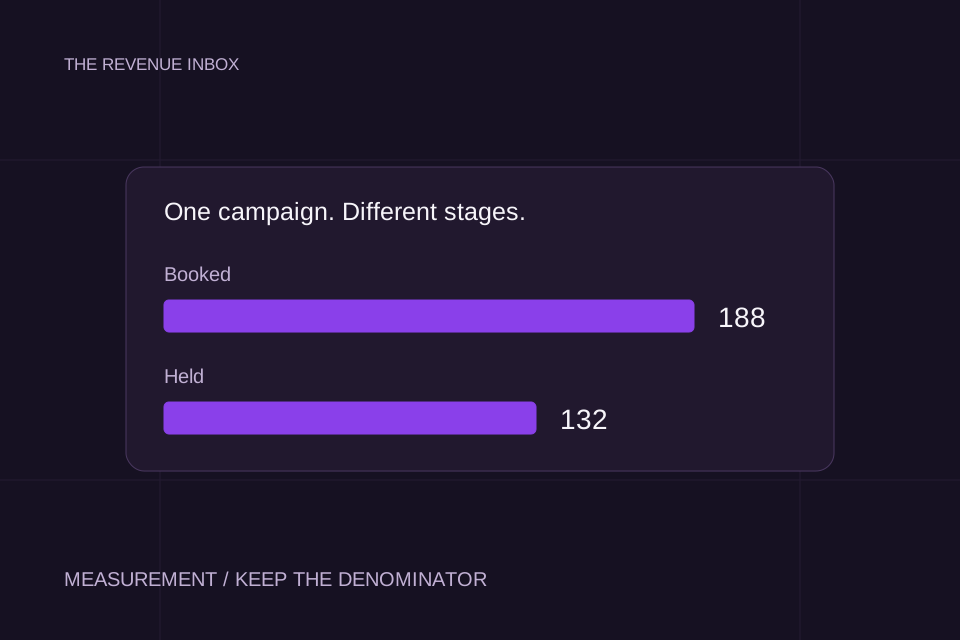
Similarity is the bridge, not a promise of the same result. An investor meeting is not a sales customer. A positive reply is not revenue. Our recruitment campaign reports one positive reply per 115 emails; it does not say every 115 emails produced a booked meeting.
4. A useful resource for a visible project
Use this when the reader is working on something you can see, and you have a resource that reduces the work. This is a good place for a checklist, a short spreadsheet or an ungated guide.
Subject: [project] checklist
Hi [first name],
I saw [public detail about the project].
We put together a [specific resource] for [specific decision]. It covers [one useful item].
Want me to send it over?
The resource should be useful without a sales call. If you promise a checklist, deliver a checklist. If the only next step is booking your calendar, this is the wrong template.
5. A referral request when ownership is unclear
Use this when the company fits but you cannot confirm who owns the problem. Do not send the same question to a dozen people at the company at once.
Subject: who owns [responsibility]?
Hi [first name],
I'm trying to reach the person responsible for [specific responsibility] at [company].
We provide [clear service] for [relevant type of team].
Is that your area, or is there someone else I should contact?
If ownership is already obvious, contact that person directly. Do not pretend to know a colleague or imply someone referred you when they did not.
6. A follow-up that adds evidence
Use this after a first message when you have a genuinely relevant detail to add. Reply in the actual thread. Google's sender guidance warns against a misleading “Re:” on a new message.
Hi [first name],
One detail I left out: [relevant example or evidence you can substantiate].
The useful part for [company] may be [specific connection].
Should I send [the same concrete next step you offered]?
Do not paste a different service menu into the follow-up. Keep the original offer and add evidence that helps the reader judge it. Stop when someone opts out. A new angle is not permission to keep contacting a person who asked you to stop.
7. A final message that leaves the choice with them
Use this to close a short sequence without guilt, false urgency or a fabricated deadline.
Hi [first name],
I'll leave this here for now.
If [specific problem] becomes a priority, I can share [useful next step].
Thanks for reading.
Do not add a meeting link, three new offers and a “last chance” warning. The purpose is to end cleanly. If someone later gives you a real reason to reconnect, write about that reason rather than pretending the old sequence is new.
Make the template yours before sending
For each email, answer four checks:
- Why this company? Name the evidence behind its fit.
- Why this person? Confirm their role relates to the offer.
- Why this message? Connect the observation to something you actually sell.
- What happens after yes? Have the resource, breakdown or next step ready.
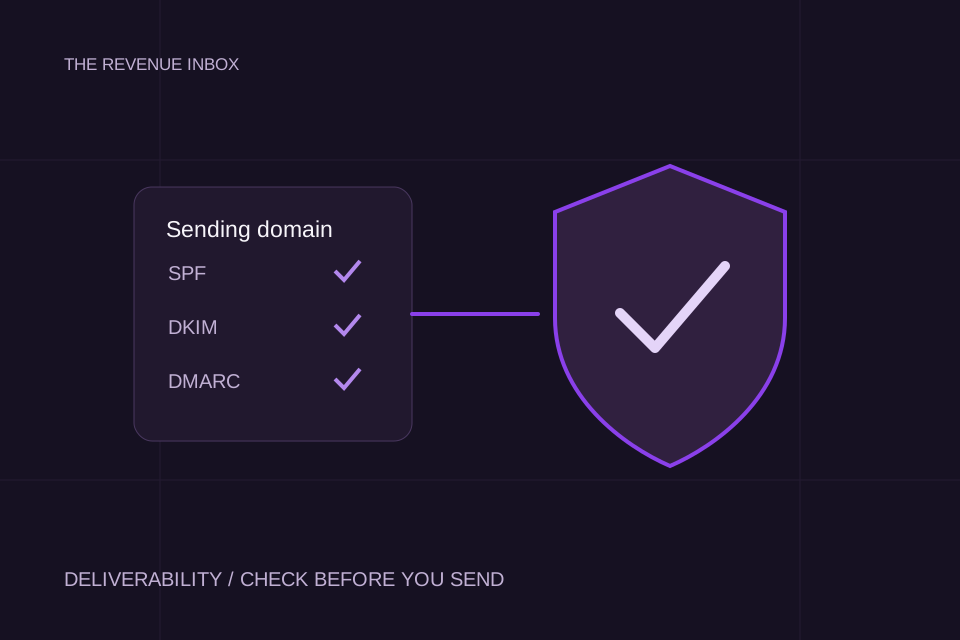
Then read it aloud. Remove any sentence you would not say to that buyer. If you are unsure whether the message is reaching the inbox, work through the deliverability checklist before rewriting every line.
Keep the first test narrow. Record which template and audience each contact received. Use separate reply and meeting metrics so a flood of “not interested” responses cannot masquerade as progress.
Sources and working
These are original writing examples, not messages claimed to have produced campaign results. The linked recruitment case contains the actual campaign email and its reported result. Google guidance was checked on 16 October 2026.