Track cold email with separate counts for unique prospects, messages, human replies, positive replies, qualified bookings and held meetings. Every rate needs a named denominator and a defined time window. Otherwise two dashboards can show different percentages for the same campaign and both appear correct.
Start with a scorecard you can reconcile to the underlying records. Use it to locate the stage that needs work before changing the whole campaign.
Choose the unit before calculating the rate
A prospect can receive an initial email and several follow-ups. That creates more messages than people. Dividing replies by messages answers a different question from dividing replying prospects by contacted prospects.
For an audience-level scorecard, count unique prospects receiving at least one message. Deduplicate repeat replies from the same person. Keep automated responses separate from human responses and record how you classify an ambiguous reply.
For an operational sending report, retain message count, bounces and rejection records. Do not relabel messages as leads. Keep both reports if you need them, with units visible.
A scorecard with explicit formulas
The definitions below are a suggested reporting convention. If your software uses a different convention, label that difference before comparing it.
Swipe to see all columns.
| Metric | Numerator | Denominator | What it tells you |
|---|---|---|---|
| Human reply rate | Unique prospects with a human reply | Unique prospects contacted | Whether people are responding, including negative responses |
| Positive reply rate | Unique prospects with a positive reply | Unique prospects contacted | Whether the offer is starting interested conversations |
| Positive share of replies | Unique prospects with a positive reply | Unique prospects with a human reply | How much of the response is useful interest |
| Qualified booking rate | Qualified meetings booked | Unique prospects contacted | How outreach becomes agreed conversations |
| Attendance rate | Meetings held | Meetings booked in the same eligible group | How bookings become actual conversations |
| Close rate | Customers won | The defined group of qualified opportunities or held calls | How sales conversations become customers |
Multiply the fraction by 100 to express it as a percentage. Define “positive,” “qualified” and “held” in the report itself. If you count several meetings with one account, disclose that rather than quietly comparing them with unique-account results.
A real example: 188 booked is not 188 held
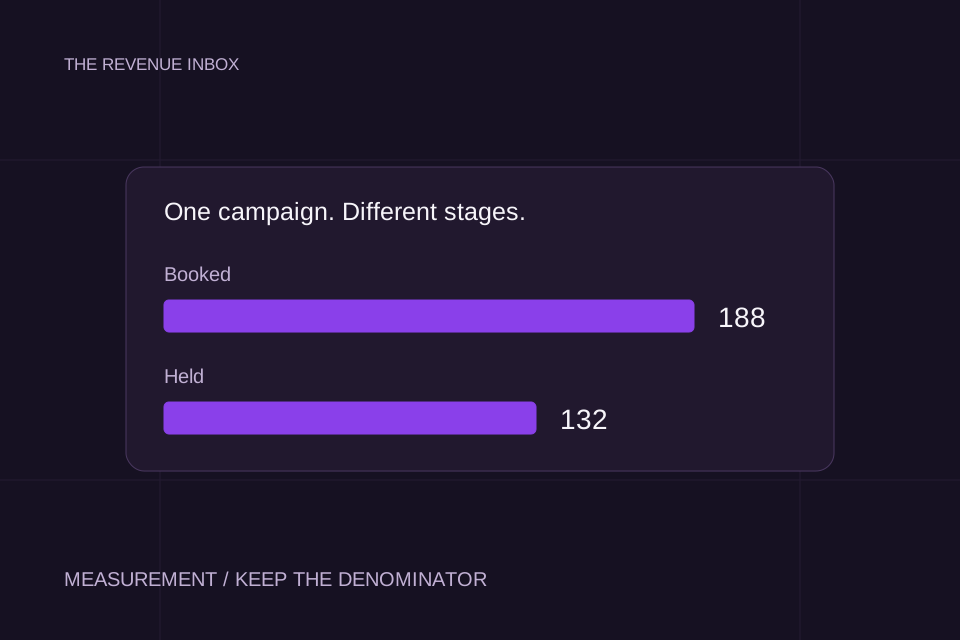
The Networked fundraising campaign reports 188 meetings booked and 132 held. Using those published counts, 132 ÷ 188 × 100 is approximately 70.2%.
That is a calculated booked-to-held ratio for one fundraising engagement. It is not an attendance target for your sales campaign. The aggregate counts also do not explain why each unheld meeting did not happen.
Keep the case's wider outcome in context: fundraising activity is not interchangeable with selling a B2B service. Read its counting definitions before reusing any number in a forecast.
A denominator can change the apparent benchmark
Our sales recruitment case reports one positive reply per 115 emails. Expressed per message, that is approximately 0.87%. It is not a unique-prospect reply rate, because the denominator is emails.
Do not compare it directly with a tool report dividing positive replies by contacted people. Do not turn it into a meeting rate. The original unit is part of the result.
When someone quotes a “good cold email reply rate,” ask what counts as a reply, what was divided by what, whether follow-ups are included and which audience produced it. A precise percentage without those answers can still be a poor comparison.
Keep time windows aligned
A campaign sent late in the month can produce replies and held meetings in the following month. Reporting this month's held calls divided by this month's bookings can mix groups at different stages.
Use cohorts when you need a conversion rate. For example, define a group by its first-contact period, then update its outcomes as replies and meetings mature. For attendance, use a group whose scheduled meetings have had time to occur. State how you handle reschedules and cancellations.
Keep the calendar-month activity report too if it helps operations. Just call it an activity report rather than pretending it is a clean conversion funnel. Do not mark a future meeting as a no-show because it has not happened yet.
Use the scorecard to choose the next investigation
- Sending errors rise: inspect the infrastructure and recipient records before rewriting copy.
- Human replies arrive but few are positive: review targeting, objections and the offer. Read actual replies rather than only the total.
- Positive replies stall before booking: inspect response ownership, follow-up and the proposed next step.
- Bookings do not become held calls: review the eligible meeting group, qualification and scheduling records.
- Held calls do not become customers: inspect fit, sales outcomes and the sales cycle before blaming the first email.
These are places to investigate, not diagnoses a percentage can prove on its own. Change one material variable at a time when possible and record what changed. Use the template guide when the evidence points to messaging.
End the weekly review with a decision
Keep a short record: date range, audience, message version, each stage count, the denominator for each rate and the action you will take next. Attach a redacted example that explains the pattern, such as an objection appearing repeatedly in replies.
Separate the campaign's activity from its economics. In an appointment-based offer, the billable event needs a written definition. Revenue belongs to a later stage and may arrive on a different sales cycle.
Choose the next action from the records. A rising reply rate is useful only when you understand what people are replying to and whether those conversations belong in your pipeline.
Sources and working
The 188 booked and 132 held counts come from the Networked fundraising case. The 70.2% figure is calculated here as 132 divided by 188. The recruitment campaign's one positive reply per 115 emails uses emails, not unique prospects, as its denominator. Neither case is an industry benchmark.